
India Has The Talent. So Why Are We Missing The AI Race?

The ingredients are here — talent, scale, ambition. What is still missing is the appetite to build at world scale.
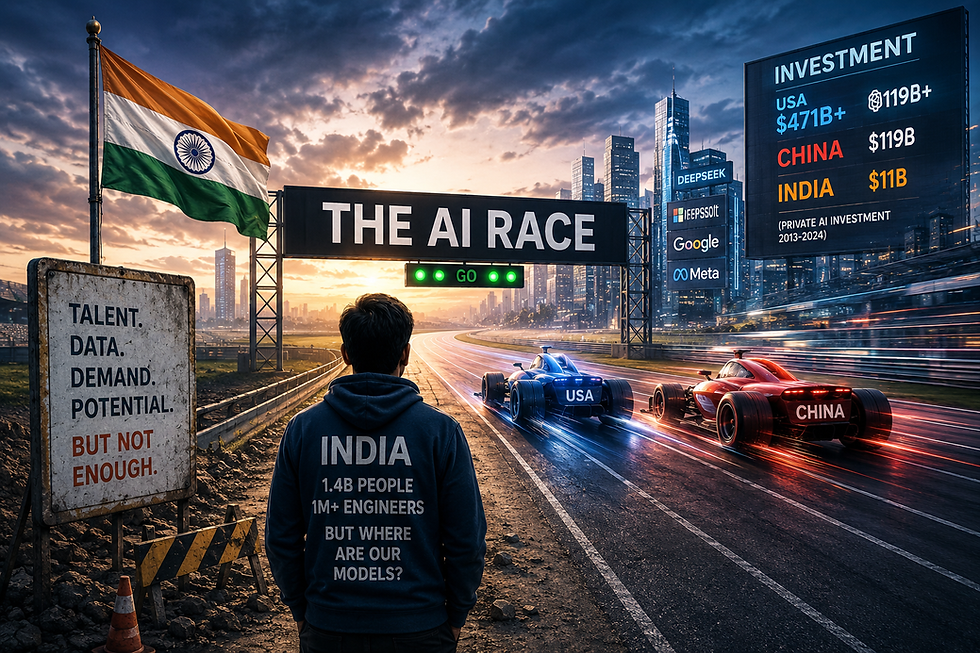
Let us begin with an uncomfortable question.
When the defining technology of the next thirty years is being built, where exactly is India?
Not in the headlines. Not in the list of frontier AI companies. Not among the creators of the foundational models reshaping business, science, education, defence, media, and work.
And that should bother us.
Because India is not short of intelligence. We are not short of engineers, coders, researchers, founders, or users. We have scale. We have talent. We have data. We have problems large enough to justify world-class innovation.
Yet, in the global AI race, India still looks less like a builder and more like a very large customer.
The world is constructing the engines of the future. We are still discussing the roadmap.
That is the real concern.
The numbers tell part of the story.
Private AI investment in the United States has crossed $470 billion. China follows at well over $100 billion. India's cumulative private AI investment between 2013 and 2024 stands at roughly $11 billion. Respectable at first glance — until you compare what the leading nations are actually producing.
The gap is not simply about money. Countries have solved money problems before. The gap is about ambition. Look at what is happening elsewhere.
OpenAI’s ChatGPT reached one million users in five days. Today, hundreds of millions use AI tools every week. Microsoft is committing tens of billions of dollars annually to AI infrastructure. Meta is doing the same. OpenAI, Oracle, and SoftBank are talking about investments that resemble nation-building projects more than technology ventures.
These are not ordinary software bets. They are infrastructure bets. Think highways. Power grids. Ports. The countries and companies building AI infrastructure today are not merely creating products. They are shaping the rules, standards, platforms, and economic architecture of the digital age. And history offers a simple lesson: those who build infrastructure rarely remain dependent on those who do not.
Then came another reminder — this time from China. A relatively lesser-known company, DeepSeek, suddenly entered global conversation by producing an AI model that rivalled leading Western systems in important benchmarks, reportedly at dramatically lower cost. The world reacted with surprise. It should not have.
China did not produce DeepSeek through luck or entrepreneurial magic. It built universities. Research pipelines. State support. Capital flows. Industrial alignment. Long-term strategic intent. DeepSeek was not an accident. It was an ecosystem showing results. That distinction matters.
To be fair, India has not done nothing. The government’s IndiaAI Mission, approved in 2024, is a serious acknowledgement that artificial intelligence matters. It includes plans around compute infrastructure, indigenous model development, startup support, datasets, and skilling. Centres of Excellence have been announced across sectors such as healthcare, agriculture, cities, and education. More importantly, India’s talent story is genuinely impressive.
According to the Stanford AI Index, India ranks extraordinarily high in AI skill penetration. We are among the world’s largest developer ecosystems. AI capability within our workforce has expanded rapidly over the last decade. Indian founders and engineers are present in almost every major global technology company. This is not a country lacking human capital.
If anything, our problem is more frustrating precisely because the ingredients are already here. Some promising Indian initiatives deserve recognition. Sarvam AI. BharatGen. Multilingual models built for Indian languages. Early efforts at indigenous AI capability. These are meaningful beginnings.
But let us also be honest enough to say what many people privately know. Beginnings are not breakthroughs. And India is still very far from building globally competitive frontier AI systems.
Here is the scale problem in plain language. India’s national AI mission allocates roughly ₹10,371 crore over five years — approximately $1.25 billion. That sounds substantial in a government press release. In the real world of frontier AI, it is modest. OpenAI alone is estimated to spend several billions of dollars annually simply running its systems. Not building them. Running them. Read that again.
Our multi-year national allocation is smaller than what some leading players spend in a single year operating their models. This is not criticism for the sake of criticism. It is simply a question of arithmetic. We cannot aspire to global leadership while budgeting for respectable participation.
The second problem is structural. India’s technology sector is immensely capable. But much of our AI ecosystem remains concentrated at the application layer. We build wrappers. Integrations. Services. Products that sit on top of models built elsewhere. There is value in that. Real businesses can emerge from that. But let us not confuse application success with foundational capability.
Owning the model is different from building on the model. One is tenancy. The other is ownership. And building frontier models is brutally difficult. It requires enormous GPU clusters, long-term funding, elite research culture, tolerance for failure, and investors willing to think in five- and ten-year horizons rather than quarterly returns.
This is where India’s traditional strengths begin to collide with its limitations. Our private sector is excellent at execution. Less proven at funding high-risk, long-gestation deep-tech research at massive scale. Our policy culture is energetic in committees, frameworks, consultations, and guidelines. Less so in making moonshot bets. Meanwhile, the world is moving.
The United States treats AI as strategic competition. China treats AI as a national capability. India often treats AI as an important emerging sector that requires further discussion. There is a difference.
So what needs to change?
First: scale the ambition. Not just the rhetoric. The spending. India needs a serious, long-horizon AI fund dedicated to compute infrastructure, foundational research, and indigenous model development — protected from annual policy mood swings and budget cycles.
Second: build compute capacity aggressively. The IndiaAI compute initiative is a welcome step. But frontier AI training today operates at scales that dwarf what most people imagine. If India wants sovereign capability, access to world-class compute cannot remain an afterthought.
Third: stop leaving collaboration to goodwill. India’s IITs, IISc, startups, established technology firms, and government institutions need deeper structural collaboration — not ceremonial partnerships announced at conferences. National capability does not emerge from isolated brilliance. It emerges from organised ecosystems.
Finally, and perhaps most importantly, we need to stop confusing AI adoption with AI leadership. The fact that millions of Indians use AI tools is not evidence of technological power. Consumption is not creation. Using someone else’s intelligence at scale does not automatically make you an AI leader. Building it does. India still has a window. That is the good news.
We possess extraordinary engineering talent. Our linguistic diversity makes our data landscape uniquely valuable. Our domestic market is enormous. And there is a credible opportunity for India to build trusted AI systems suited not only for itself but for much of the Global South. But opportunities do not remain open forever.
The models being trained today, the chips being purchased today, the infrastructure being deployed today — these decisions will shape economic power for decades. The question is no longer whether India has the talent. We do.
The question is whether we have the urgency, scale, and seriousness to match it. Because the AI race is not approaching. It is already underway. And right now, India is not running as fast as it should.


Comments